By Vinay Kumar, NIOS Coordinator, Presidency Public School, Bengaluru
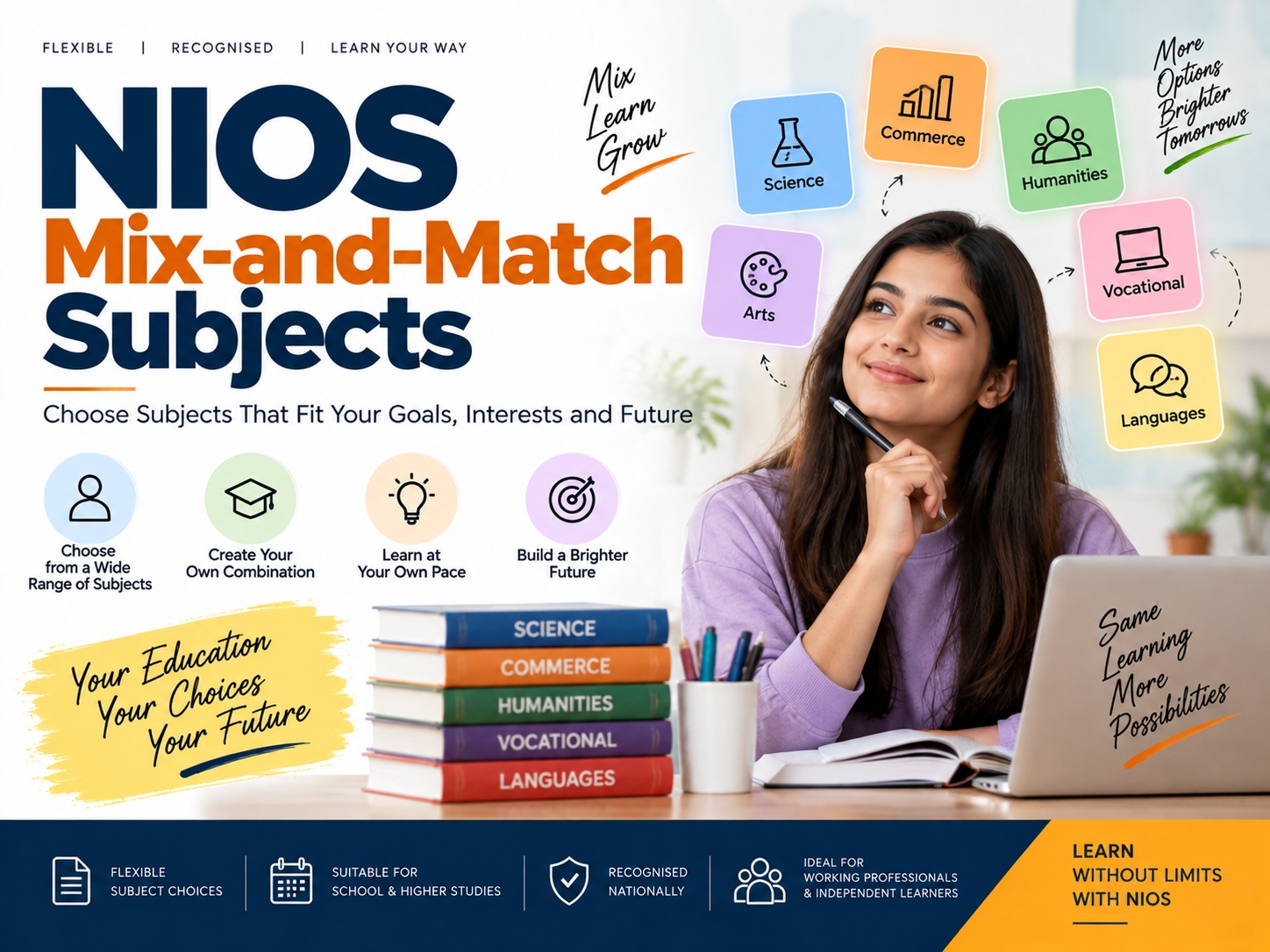
Choosing subjects after Class 10 is one of the most important decisions a learner can make. For many students, the traditional idea of selecting a fixed stream — Science, Commerce or Arts — does not always match their interests, learning style or career goals. This is where the National Institute of Open Schooling (NIOS) offers something different: the flexibility to select subjects based on your actual needs and future plans.
But flexibility does not mean selecting subjects randomly. A good subject combination should have a clear purpose. Before exploring the options NIOS provides, students enrolled at NIOS study centres in Bangalore should understand one key principle: career requirement comes first, flexibility second.
What Does “Mix-and-Match Subjects” Mean in NIOS?
NIOS Senior Secondary offers subjects such as Mathematics, Physics, Chemistry, Biology, History, Geography, Political Science, Economics, Business Studies, Accountancy, Psychology, Computer Science, Sociology, Painting, Mass Communication, Data Entry Operations, Environmental Science, Tourism and more.
Learners can select subjects from this range, subject to the applicable NIOS scheme of studies, passing criteria, certification rules and the requirements of the university or institution they plan to join later. NIOS also permits vocational subjects to be combined with academic subjects under its programmes — giving learners exposure to both knowledge and practical skills.
This flexibility is valuable — but it must be used with a plan. Review the available NIOS study materials for each subject before making your choice, so you understand the workload and content.
5 Practical Subject Combination Examples
1. Humanities + Data Entry Operations
For students interested in office administration, digital documentation or social-sector work, a combination of History, Political Science, Psychology or Economics alongside Data Entry Operations can be highly effective. The humanities subjects develop communication and critical thinking, while Data Entry Operations builds practical computer skills — a combination suited for administrative and digital support roles.
2. Science + Painting (Creative Science)
Students who love science but also have a strong creative streak may explore a combination including science subjects alongside Painting, where the applicable NIOS rules permit it. This suits learners interested in scientific illustration, design or visual communication. However, always verify the eligibility requirements of your intended course first — a creative subject should not replace a compulsory requirement.
3. Commerce + Computer Skills
Learners interested in business, accounting or entrepreneurship may consider Accountancy, Business Studies and Economics alongside a digital subject such as Data Entry Operations or Computer Science. Modern workplaces increasingly require both subject knowledge and digital proficiency, making this a future-ready combination for commerce-oriented students.
4. Psychology + Sociology + Humanities
Students drawn toward social work, counselling, education or community development may find a combination of Psychology, Sociology, Political Science and History especially valuable. This builds an understanding of human behaviour, social institutions and cultural contexts — a strong foundation for degree programmes in social sciences or education.
5. Science + Computer Science
For students aiming at technology, engineering or computer-related higher education, subjects such as Mathematics, Physics, Chemistry and Computer Science form a natural combination. However, this requires careful verification — students should confirm the exact eligibility requirements of their intended institution before selecting subjects. Do not assume; always check first.
A 5-Step Subject Selection Method
Before selecting NIOS subjects, every learner should follow a structured process:
- Identify your career direction — What type of work or higher education interests you? Start here, not with “which subject is easiest.”
- Identify the next course — What degree or diploma do you plan to pursue after Class 12? Check its eligibility requirements carefully.
- Separate required from interest subjects — List compulsory subjects for your intended programme first, then identify complementary subjects based on interest.
- Check NIOS combination rules — NIOS has subject-group rules, passing criteria and practical requirements. Some subjects have practical components (Physics, Chemistry, Biology, Computer Science, Painting, Data Entry Operations). Confirm before finalising.
- Verify university eligibility — Before admission, confirm with two or three colleges offering your intended degree that your NIOS subject combination meets their requirements.
What Parents Should Avoid
A common mistake is selecting NIOS subjects based on ease, prestige or what another student chose. The right question is not “Which subjects are easiest?” — it is “Where does this combination take the learner after Class 12?”
Parents and students who are unsure about career direction should choose subjects that match genuine interests, keep realistic future options open and remain manageable for the learner. Career plans naturally evolve — the goal is to avoid closing doors unnecessarily. Learners who need additional academic support during subject preparation should also explore the NIOS programme for slow learners, which provides a flexible and supportive environment for students who need more time.
Final Thoughts
The real advantage of NIOS’s flexible subject structure is the ability to create an educational pathway that genuinely fits the learner — not simply a default stream chosen because everyone else followed it. A student interested in commerce needs a different combination from one interested in creative arts; a student still exploring their interests needs a combination that keeps multiple realistic options open.
NIOS provides flexibility. But that flexibility works best when it is guided by purpose. Choose the career direction. Check the higher-education requirements. Understand the NIOS rules. Then select the combination. That is the right approach to Mix-and-Match Subjects in NIOS.
Important: NIOS rules, available subjects and admission requirements can change. Students should verify the current NIOS prospectus and the eligibility requirements of their intended university before finalising subjects.
About the Author: Vinay Kumar is an NIOS Coordinator at Presidency Public School, Bengaluru — an NIOS study centre. He works with learners and parents on NIOS admission, subject selection, academic planning and examination preparation.