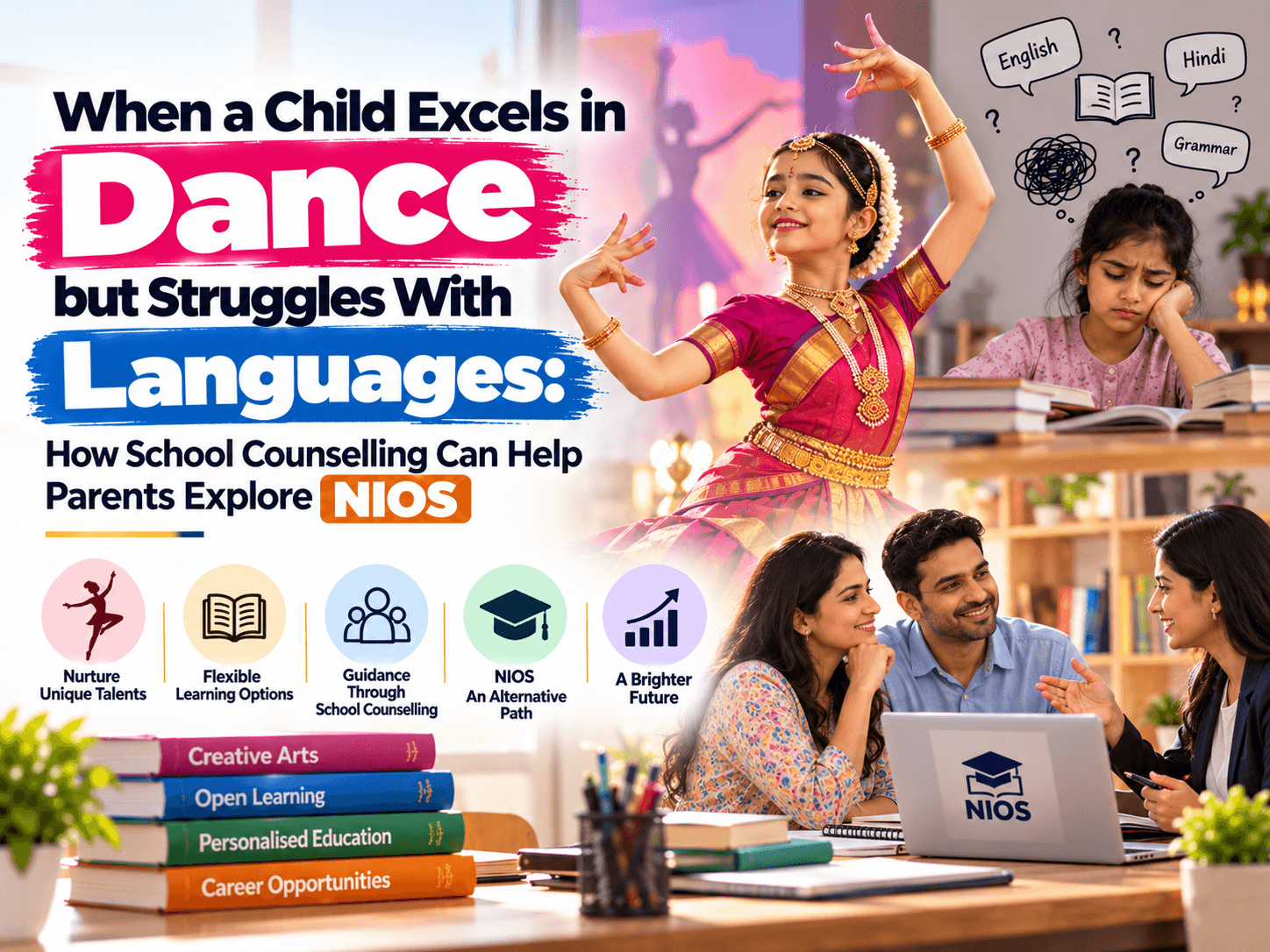
Every child has a different combination of abilities, interests, and learning needs.
Some children are naturally drawn towards dance, music, sports, art, or other creative activities. They may be energetic, expressive, enthusiastic, and capable of learning complex movements or routines. At the same time, they may experience persistent difficulties with particular academic subjects, especially languages.
For parents, understanding this difference can be challenging.
They may see their child practising dance enthusiastically for hours, remembering choreography, and performing confidently on stage. Yet the same child may struggle with Hindi vocabulary, reading, spelling, writing, or language examinations.
Parents may begin asking themselves:
- Why can my child learn dance so enthusiastically but struggle with certain language lessons?
- Does my child need a different teaching approach?
- Should we consult a school counsellor or a specialist?
- Can the school provide the support my child needs?
- Are there other recognised educational pathways that we should consider?
These questions deserve careful attention rather than quick conclusions.
A child’s difficulty with a language does not, by itself, establish a learning disorder or indicate a lack of intelligence. Understanding the underlying difficulty requires appropriate assessment and consideration of the child’s educational history.
Sometimes, the most helpful step is to bring parents, school counsellors, qualified specialists, and educational advisers together to explore the available options.
1. A Parent’s Journey: From School Counselling to Exploring NIOS
Consider an anonymised case based on a parent’s experience.
A student studying in Class 8 under an international curriculum was highly active and passionate about dance. Dance was an important interest, and the student showed considerable enthusiasm for participating in activities outside the classroom.
However, the student experienced significant difficulty with Hindi and other language-related learning demands.
The parents were concerned. They could see their child’s enthusiasm and abilities in one area, but they were also worried about the continuing academic difficulties.
Instead of ignoring the problem, the family approached the school’s counsellor.
The counsellor listened to the concerns and recommended further specialist evaluation at the National Institute of Mental Health and Neurosciences (NIMHANS) in Bengaluru.
The family then pursued further assessment to better understand the child’s learning needs. Following discussions about the child’s circumstances and possible educational pathways, NIOS emerged as an option worth exploring.
The important point in this story is not that every child who struggles with Hindi should move to NIOS.
It is that the family began looking for an explanation and a suitable educational arrangement rather than simply expecting the child to try harder.
The school counsellor helped open the door to further investigation, and the family began exploring options based on the child’s individual circumstances.
The student’s privacy should always be protected when sharing such experiences publicly. No diagnosis or personal medical information should be disclosed without the family’s informed consent.
2. Why Can a Child Be Active and Talented but Struggle Academically?
Parents sometimes assume that a child who is intelligent, energetic, and talented should find every school subject equally manageable.
In reality, learning involves many different skills.
Dance may involve movement, coordination, rhythm, observation, memory, practice, and expression. Language learning involves a different combination of skills, including listening, understanding vocabulary, reading, spelling, written expression, and remembering language structures.
A child may find some of these tasks easier than others.
Persistent language difficulties can have several possible explanations, including differences in prior exposure to a language, teaching methods, gaps in foundational learning, language-processing difficulties, or a specific learning difficulty.
These possibilities cannot be distinguished reliably from a short description of the child’s behaviour or academic performance.
A qualified professional may consider the child’s developmental history, educational experiences, language background, and performance across different tasks before recommending appropriate support.
Parents should avoid labelling the child as lazy, careless, or incapable simply because one subject is difficult.
Instead, they should try to understand which skills are challenging and what support may help.
3. The Role of a School Counsellor
A school counsellor can play an important role when parents notice a continuing mismatch between a child’s strengths and academic performance.
The counsellor may help the family understand the concerns, communicate with teachers, consider available school-based support, and identify whether a specialist assessment would be appropriate.
A referral to a specialist does not automatically mean that a child has a medical condition or learning disorder. It is a step towards obtaining a clearer understanding of the difficulties.
In this case, the school counsellor’s recommendation to seek further evaluation at NIMHANS helped the family investigate the concern beyond the classroom.
NIMHANS provides child and adolescent psychiatry services and may guide families towards further assessment or other relevant services depending on the child’s needs.
A useful assessment can help parents and educators better understand the child’s strengths, difficulties, and possible support requirements.
The findings should inform educational decisions rather than become a label that limits the child’s opportunities.
4. The Practical Challenge: What Can a Mainstream School Provide?
Many parents understandably expect their child’s school to provide the support necessary for academic progress.
Schools may offer additional explanations, remedial classes, counselling, learning accommodations, or other support, depending on their resources, policies, and applicable requirements.
However, parents can sometimes find that the support available does not fully address their child’s individual needs.
For example, a student may require repeated explanations, a different pace of instruction, or substantial additional help with a particular language.
A school timetable is usually designed for an entire class. Teachers must teach the prescribed curriculum, manage classroom activities, assess students, and meet academic requirements.
Providing a separate teacher for one student throughout the school day may not always be feasible within the school’s staffing and operational arrangements.
Similarly, asking a student to sit separately is not necessarily an appropriate or sufficient solution. Any separate-room arrangement or other accommodation should be based on the student’s needs, applicable rules, and the school’s ability to provide suitable supervision and support.
The important distinction is between recognising a child’s needs and assuming that every school can meet every need through the same arrangement.
Parents should discuss the available support with the school and investigate reasonable accommodations before concluding that a change of educational pathway is necessary.
5. Can NIOS Be an Alternative for a Student Who Struggles With Languages?
The National Institute of Open Schooling (NIOS) offers Secondary and Senior Secondary education through an open schooling system.
For eligible students, NIOS may provide a different way to organise their education and select subjects from the approved options, subject to its admission, certification, and examination requirements.
One reason families investigate NIOS is the flexibility associated with its subject-selection framework.
At the Secondary level, NIOS requires a learner to pass a minimum of five subjects, including at least one and no more than two languages, for the pass certificate. The available subject combinations must be checked against the current official prospectus and certification requirements.
This means parents may be able to explore a subject combination that does not require the student to take two languages, provided the student meets all applicable requirements.
However, this is not the same as a blanket exemption from every language requirement. A student must still meet NIOS’s prescribed certification rules.
Parents should also understand that NIOS does not automatically diagnose or resolve a child’s learning difficulties. Appropriate teaching, specialist support where necessary, and a realistic study plan remain important.
Why subject selection matters
For a student who finds a particular language especially difficult, understanding the available subject combinations may help the family assess whether an alternative academic arrangement is more suitable.
Before making a decision, parents should verify:
- The student’s eligibility for NIOS admission.
- The approved subjects available at the relevant level.
- The minimum number of subjects and language requirements for certification.
- Any practical, assessment, or examination requirements.
- The eligibility requirements of the student’s intended future course or institution.
Official information is available through the NIOS website: https://nios.ac.in/
6. Are CBSE and ICSE Unable to Support Students With Language Difficulties?
It is important not to assume that conventional boards have no provisions for students with learning difficulties.
CBSE has published provisions for eligible students with disabilities and special educational needs, including certain examination facilities and concessions. The specific support available depends on the applicable rules, documentation, and eligibility requirements.
Similarly, the CISCE regulations provide for an exemption from the second-language requirement in cases that meet the prescribed criteria relating to the severity of a candidate’s learning disability.
These provisions do not mean that every student who struggles with Hindi will qualify for an exemption. The nature of the difficulty, the applicable regulations, supporting documentation, and the process followed by the school or board all matter.
Parents should therefore compare the actual options available under their current board with the options offered by NIOS.
The comparison should consider not only language requirements but also the curriculum, academic support, examination structure, future eligibility, and the student’s overall circumstances.
A change to NIOS should be considered because it is appropriate for the child—not because of an assumption that every other board is unable to provide support.
7. Why NIOS May Be Worth Exploring for Some Families
For some students, the challenge is not simply a single difficult subject. It may involve a combination of academic pressure, a mismatch between the learning environment and the student’s needs, and the difficulty of balancing school requirements with other commitments.
In such situations, open schooling may be worth investigating.
Potential considerations include:
Subject selection: The family can examine approved subject combinations within the applicable certification requirements.
Study arrangements: Depending on the student’s circumstances, open schooling may offer greater flexibility in how study time is organised.
Academic support: Students can explore coaching or other teaching support alongside their NIOS studies.
Future planning: Parents can assess the qualification requirements for the student’s intended higher education or career pathway before selecting subjects.
NIOS is not automatically easier than other boards. Students still need to study the prescribed syllabus, prepare for examinations, and fulfil all applicable requirements.
The aim is to identify an educational route that fits the student’s needs while preserving meaningful opportunities for further education.
8. Why Parents Should Not Make a Decision Based on One Subject Alone
A student struggling with Hindi may need targeted language support rather than a complete change of educational board.
Another student may have difficulties across several academic areas and need a more comprehensive review of their learning environment.
A third student may be able to continue successfully in the existing school with suitable accommodations.
These situations should not be treated as identical.
Before changing the educational pathway, parents should:
- Discuss the specific difficulties with the school counsellor and relevant teachers.
- Consider specialist evaluation when recommended.
- Understand the findings and the support that may be appropriate.
- Ask the school what accommodations and academic assistance are available.
- Compare the applicable board rules and subject requirements.
- Check the eligibility requirements for future courses.
- Make a decision that considers the child’s educational, emotional, and developmental needs.
The student’s interests and views should also be heard in an age-appropriate way.
A child who loves dance should not have to abandon that interest simply because language learning is challenging. At the same time, the educational plan should help the child develop the academic skills and qualifications needed for future opportunities.
9. How SchoolBase Can Help Parents Explore the NIOS Pathway
At SchoolBase, we understand that some families approach educational counselling after spending considerable time trying to resolve their child’s academic difficulties.
They may have spoken to teachers, consulted the school counsellor, explored additional tuition, or sought professional guidance.
Their next question may be whether NIOS is a suitable option for their child’s circumstances.
SchoolBase provides NIOS Class 10 Coaching in Bengaluru and NIOS Admission Guidance for students pursuing Secondary (Class 10) and Senior Secondary (Class 12) education.
Our services include online and offline classes, subject-wise teaching, revision, examination preparation, and guidance on applicable academic requirements.
For parents considering NIOS, an initial discussion can help clarify the student’s current educational position, intended subjects, learning needs, and longer-term goals.
Where a student has received a professional assessment, parents may use the relevant recommendations to inform their educational planning. SchoolBase does not provide medical diagnosis or replace specialist assessment.
We also encourage families to verify official admission and examination requirements directly with NIOS before making a final decision.
SchoolBase is an educational coaching provider, not an examination board. NIOS is responsible for its official admission and examination processes and issues certificates to eligible students who meet its requirements.
Our role is to help families understand the academic pathway and access suitable coaching support.
10. A Message to Parents: Look for the Right Support, Not Just Higher Marks
When a child struggles with a particular subject, parents may worry about future examinations, school progression, and long-term opportunities.
These concerns are understandable.
However, a child’s difficulty in one area should not overshadow their strengths, interests, or potential for development.
The student in this case was passionate about dance and active in other areas, yet needed help addressing language-related academic difficulties.
The school’s counsellor helped the family consider further assessment. The family then explored educational options, including NIOS, to understand whether a different subject-selection framework might better suit the child’s circumstances.
The lesson is not that every student should leave an international, CBSE, or ICSE school.
It is that parents should have access to accurate information, appropriate professional guidance, and a clear understanding of the educational choices available to their child.
Sometimes, a student needs additional language support. Sometimes, the school can provide appropriate accommodations. In other circumstances, a different recognised educational pathway may be worth considering.
The right decision begins by understanding the child—not by comparing the child with classmates or judging their abilities through one subject alone.
When parents, counsellors, specialists, and educational advisers work together, families can make more informed decisions about the next stage of a child’s education.
Frequently Asked Questions
Can a student who struggles with Hindi choose NIOS?
Potentially, yes. NIOS offers approved subject combinations, and its Secondary certification requirements allow a minimum of five subjects, including one or two languages. Parents must verify admission eligibility, available subjects, certification rules, and future course requirements.
Should parents consult a school counsellor if a child struggles with languages?
A school counsellor can help the family understand the concern, communicate with teachers, and consider whether further assessment or educational support is appropriate.
Does a language difficulty automatically mean a child has a learning disorder?
No. A language difficulty can have several explanations. Assessment by an appropriately qualified professional may help identify the nature of the difficulty and the support that may be useful.
Can a student continue dance or other extracurricular activities while studying through NIOS?
Families can plan extracurricular activities alongside their studies, but the student must still meet applicable academic, practical, and examination requirements.
Does SchoolBase provide counselling or diagnosis?
SchoolBase provides NIOS coaching and educational guidance. Medical or psychological assessment and diagnosis should be undertaken by appropriately qualified professionals.
Explore NIOS Class 10 and Class 12 With SchoolBase
If your child is experiencing persistent academic difficulties and you are considering alternative educational options, take time to understand the available pathways before making a decision.
SchoolBase provides NIOS coaching and educational guidance through online and offline classes.
SchoolBase – NIOS Learning Support in Bengaluru
- Phone / WhatsApp: 63619 38556
- Website: https://schoolbase.in
- NIOS Study Centre: Presidency Public School, Ittamadu / Banashankari
- Study Centre Code: 080345
Contact SchoolBase to discuss the available coaching options and understand the academic requirements associated with the NIOS pathway.
Every child has individual strengths. The purpose of education is to help each child learn, develop, and move towards a meaningful future.