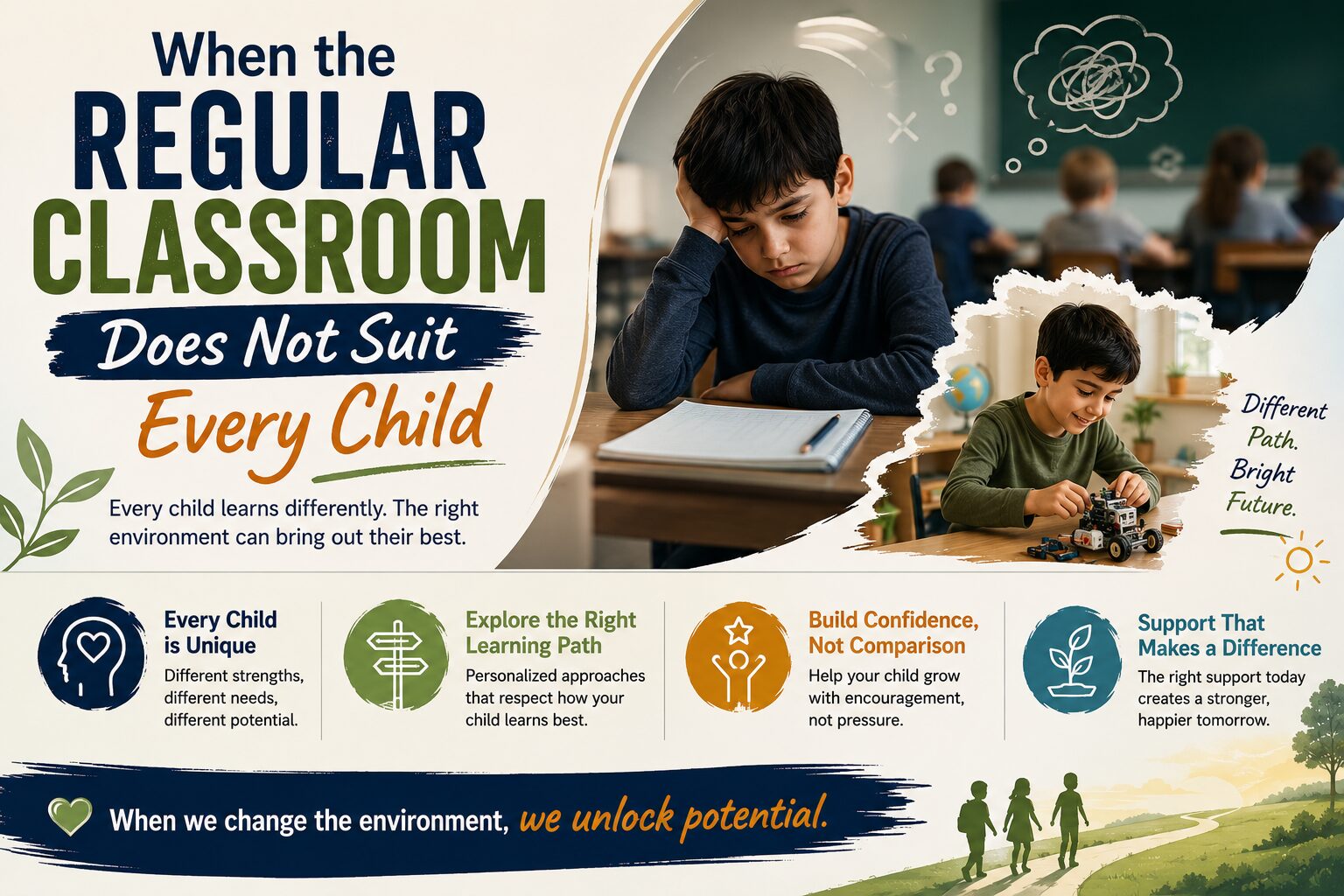
Every child is different. Some enjoy the energy of a busy classroom — learning in a group, following a fixed timetable, interacting with teachers and classmates. Others find the same environment difficult. They may need a quieter setting, more individual attention, or independent study. Some understand lessons quickly but lose engagement when everyone must follow the same pace; others need more time and lose confidence when the class moves ahead before they are ready. Some children are deeply interested in sports, music, art or technology and struggle to balance these with a conventional school schedule.
When this happens, parents often ask: “Is my child unwilling to study, or is the learning environment simply not working for them?” A child who finds the regular classroom unsuitable does not necessarily lack ability or motivation. Sometimes the answer is additional support. Sometimes it is a different teaching approach or a smaller learning environment. And for some eligible learners, a recognised open schooling pathway such as the National Institute of Open Schooling (NIOS) may be worth exploring — offering flexibility in subject choice and pace of learning, along with self-learning materials and academic support. The goal is not less education. The goal is to understand the child and find an environment in which learning can continue successfully.
Understand the Child Before Judging the Behaviour
When a child struggles, parents can become frustrated, and comments like “you don’t study” or “why can’t you be like other children” can gradually affect communication. A child who cannot say “I don’t understand what is happening in class” may simply say “I don’t want to go to school.” Changing the question from “Why are you not studying?” to “What makes studying difficult for you?” can make a significant difference — not just to the decision parents make, but to the relationship itself.
How Educational Assessment Can Help
When a child consistently struggles academically or finds the classroom environment difficult, an educational assessment can offer a clearer picture of current academic skills, learning needs, strengths, and areas requiring support — covering reading and writing ability, mathematical understanding, study habits, and learning preferences. The purpose is not to attach a label; it is to understand the child better, and should involve an appropriately qualified professional where specialist assessment is needed. When parents understand why a child is struggling, the conversation can shift from blame to support — strengthening trust between parent and child.
Not Every Child Learns the Same Way
A conventional classroom suits many students well, but children have different strengths and preferences. Some learn best through discussion, others through independent reading; some need repeated explanation, others move ahead quickly. NIOS describes its Secondary and Senior Secondary programmes as offering flexibility in subject choice and pace of learning, supported by self-learning materials — a structure that may help students who find the classroom either too fast or too slow, or who simply concentrate better in a quieter, more individualised setting.
Creative and Sports-Focused Children Need Time Too
A young musician needs time to practise, an artist needs time to create, an athlete needs time to train. These interests should not automatically replace academic education. The better question is: “How can my child study effectively while also developing their strengths?” Flexibility only works alongside responsibility — a NIOS student still needs to follow course requirements, prepare for examinations, and maintain a consistent study routine. Flexible does not mean effortless; it may require more personal discipline, not less.
Is NIOS Recognised for Higher Education?
NIOS states that its certificates are valid and recognised at par with other National and State Boards, and that Senior Secondary learners can seek admission to universities and professional colleges where they meet that institution’s specific eligibility requirements. Recognition does not mean every course has identical requirements — required subjects, minimum marks, and entrance exam eligibility should always be checked before finalising subject choices, especially for professional courses like engineering or medicine.
Who Should — and Shouldn’t — Consider NIOS Right Away?
Families may find it worth exploring for students who struggle with the conventional classroom pace, have serious sports or creative commitments, have discontinued regular schooling, or need a more flexible routine. NIOS may not suit a student who needs constant classroom supervision, struggles with self-directed learning, or whose future course has specific subject requirements not yet checked. One difficult academic year does not automatically mean a student needs to leave regular school — counselling should come before any decision.
SchoolBase and NIOS Academic Guidance
At SchoolBase, we work in association with Presidency Public School – NIOS Study Centre, Code 080345, guiding families on NIOS Class 10 admission, NIOS Class 12, subject selection, and documentation requirements. We do not believe every student who finds regular schooling difficult should automatically move to NIOS — explore our learning support options or review the fee structure before deciding. SchoolBase does not issue NIOS certificates; certification is handled by NIOS under its own rules.
A Child Who Doesn’t Fit the Classroom Pattern Is Not a Failed Child
A student who finds the classroom difficult is not automatically less capable. For many children, regular schooling remains the right choice; for others, additional support makes it successful; and for some eligible learners, open schooling may provide a better fit. Understand the child, understand what is and isn’t working, and consider an assessment when it helps clarify needs — then choose thoughtfully.
Frequently Asked Questions
Why might a child struggle with the regular classroom?
Reasons can include academic pace, classroom distractions, the need for individual attention, a fixed routine, or competing commitments like sports and creative activities.
Does finding school difficult mean a child is not capable?
No. Difficulty with a classroom environment does not by itself determine academic ability.
Can an educational assessment help?
Yes, an appropriate assessment can clarify a student’s strengths and support needs, and should guide support rather than label the child.
Does NIOS mean a student doesn’t have to study?
No. NIOS has its own admission, subject, examination, and certification requirements. Flexibility does not remove academic responsibility.
Is NIOS recognised for higher education?
Yes, NIOS certificates are recognised at par with other National and State Boards, though students must meet each institution’s specific eligibility requirements.
Is NIOS suitable for every child who dislikes school?
No. Parents should understand why the child is struggling and assess whether NIOS matches the student’s needs, eligibility, and future plans.
Need Guidance?
SchoolBase – NIOS Academic Guidance & Learning Support
NIOS Study Centre: Presidency Public School – Code 080345, Bengaluru
Website: www.schoolbase.in
Phone: 6361938556
Important: NIOS admission, eligibility, subjects, and examination requirements are governed by applicable NIOS rules and notifications and can change. Parents should verify the latest information with NIOS before making an educational decision.
About the Author
Vinay Kumar, Academic Programme Coordinator, SchoolBase, Bengaluru, works with students and parents exploring NIOS Secondary and Senior Secondary pathways and coordinates academic support and counselling through SchoolBase. Last updated: August 2026. NIOS information checked: August 2026.