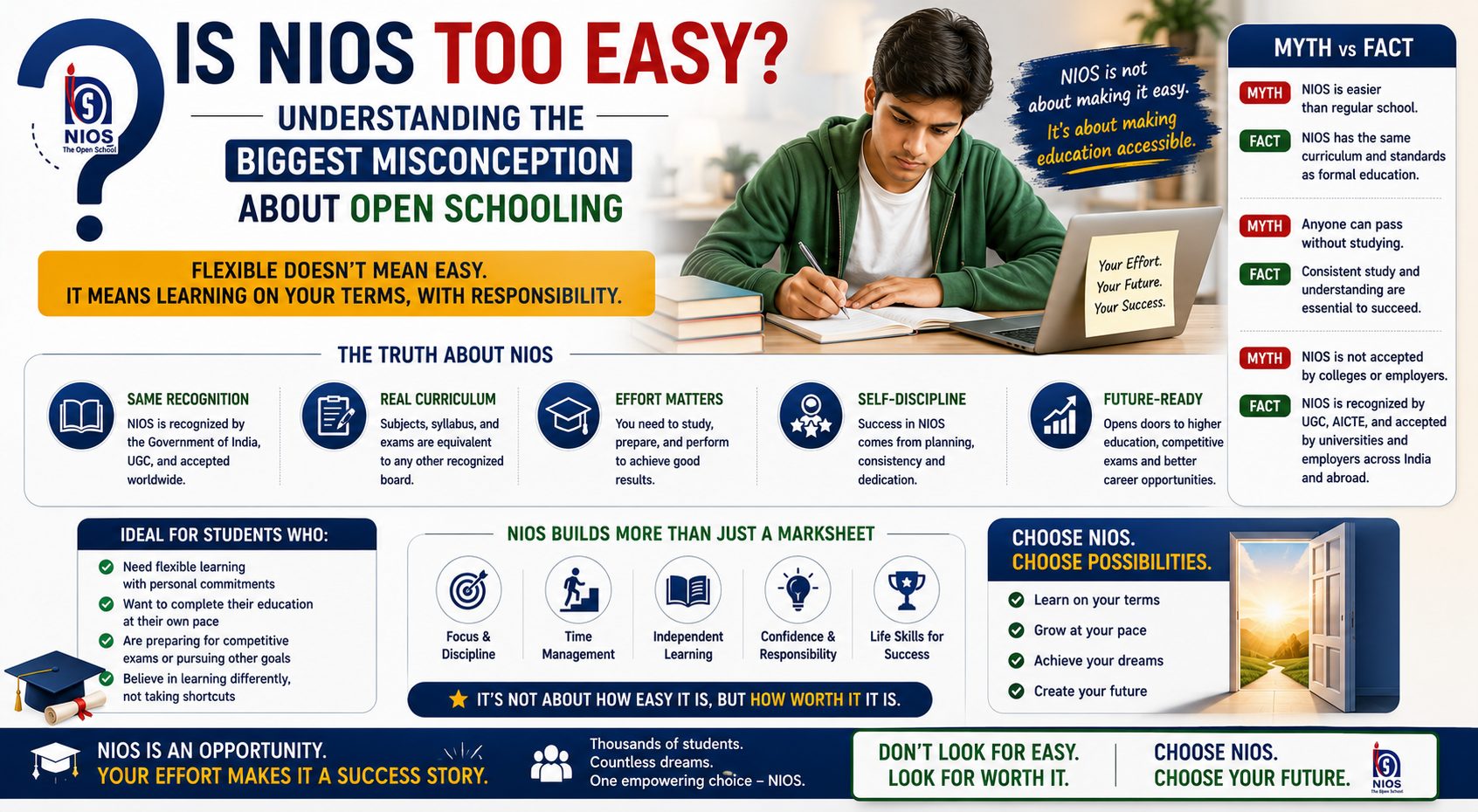
When parents first hear about NIOS, a familiar set of questions follows almost immediately. Where are the weekly tests? Why isn’t there daily homework? Can a student really succeed without tuition classes every evening? These questions reveal the most common and persistent misconception about open schooling in India — that flexibility means low standards.
The truth is very different. NIOS — the National Institute of Open Schooling — is a rigorous, government-recognised board with a structured assessment system, nationally standardised examinations, and a track record of students going on to top universities, competitive exams, and successful careers. At SchoolBase, Bangalore’s dedicated NIOS Study Centre, we address this misconception every single day. This blog sets the record straight.
Why NIOS Is Misunderstood
The misconception about NIOS being “easy” comes from a fundamental confusion between structure and rigour. Mainstream schooling uses daily homework, weekly tests, and compulsory attendance to signal seriousness. When NIOS removes these elements — replacing them with self-paced study and flexible examinations — parents interpret the absence of pressure as the absence of standards.
But rigour in education is not measured by how much stress a student experiences. It is measured by the depth of understanding required to pass assessments, the quality of the examination system, and the outcomes students achieve. On all three measures, NIOS holds its ground firmly. For a full overview of how NIOS works in Bangalore, visit our NIOS Board in Bangalore guide.
How NIOS Actually Evaluates Students
NIOS uses a multi-layered evaluation system that assesses students across three distinct dimensions — internal assignments, practical work, and public written examinations. No student receives a certificate without performing satisfactorily across all three components.
This is actually a more comprehensive assessment model than many mainstream boards, which rely primarily on a single set of annual written examinations. NIOS builds evaluation throughout the academic year rather than concentrating it into one high-stakes window.
Students enrolled through SchoolBase receive structured guidance on all three components — from NIOS Class 10 to NIOS Class 12 — ensuring they are well-prepared at every stage of the evaluation process.
TMA, Practicals, and Public Examinations Explained
Understanding the three pillars of NIOS assessment removes any doubt about the board’s academic rigour:
Tutor Marked Assignments (TMA)
Every NIOS student must complete and submit Tutor Marked Assignments for each subject. These are written assignments that assess conceptual understanding, application, and analytical thinking — not memorisation. TMAs carry 20% of the total marks for each subject. They cannot be skipped or guessed. A student who does not understand the subject cannot produce a passing TMA.
Practical Examinations
For science subjects at both Class 10 and Class 12 level, students must appear for hands-on practical examinations conducted at the study centre. These practicals carry 20% of the subject marks and require students to demonstrate real laboratory skills — not theoretical knowledge alone. SchoolBase conducts two practical sessions every month to ensure students are examination-ready.
Public Written Examinations
The NIOS public examination — which carries 60% of the total marks — is conducted by the board twice a year (April and October) and is fully standardised at the national level. Question papers are set and evaluated centrally. The same examination is written by students across India and abroad. There is no grade inflation, no school-based moderation, and no internal marking discretion. Students who do not meet the passing standard simply do not pass.
For students who prefer to appear on their own schedule, the On-Demand Examination (ODE) facility allows testing when the student is genuinely ready — which produces better outcomes, not easier ones.
Why Flexibility Should Not Be Confused with Low Standards
Flexibility in NIOS refers to when and how a student learns — not what level they must achieve. The syllabus content, examination standards, and passing criteria are set by the board and do not vary based on a student’s pace or preferred study method.
Consider this comparison: a student who prepares for a NIOS Class 12 Physics examination over 18 months of focused home study, supported by SchoolBase’s coaching, is writing the same examination as a student from a CBSE school who attended class six days a week for two years. The examiner cannot tell the difference — and more importantly, the examination cannot tell the difference. Both students either know Physics at Class 12 level or they do not.
This is what structured support from a dedicated centre like SchoolBase provides — not a shortcut to certification, but a well-organised, personalised pathway to genuine academic competence. Explore our admission process and fee structure to understand how we build this pathway for each student.
Success Stories — NIOS Students in Higher Education and Careers
The most compelling evidence against the “NIOS is easy” misconception is the outcomes achieved by NIOS students across India and at SchoolBase specifically.
- Engineering and Medicine: Thousands of NIOS Class 12 students appear for JEE Main, JEE Advanced, and NEET every year. SchoolBase students have secured admissions to engineering colleges across Karnataka and other states. Our dedicated IIT JEE Pathway programme supports NIOS Class 12 students in preparing for competitive entrance examinations simultaneously.
- University Admissions: NIOS certificates are accepted by Delhi University, Bangalore University, VTU, Manipal, and all other Indian universities. International universities in the UK, USA, Canada, and Australia also recognise NIOS qualifications.
- Government Examinations: NIOS Class 10 and Class 12 certificates are accepted for UPSC, SSC, banking, railways, and all state government recruitment examinations without distinction.
- Aviation and Specialised Careers: SchoolBase’s Aviation Pathway Programme enables NIOS students to combine their Class 12 qualification with industry-specific training — producing graduates who are both academically certified and career-ready.
These outcomes are not possible without genuine academic preparation. They are the clearest proof that NIOS students are learning at the same standard as their mainstream school peers.
The Role of Coaching and Structured Support Centres
One reason NIOS is sometimes perceived as easier than it actually is: students who attempt NIOS without proper guidance and structured support often struggle. When they fail or perform poorly, the conclusion drawn is that NIOS is unreliable — when the real issue is the absence of appropriate coaching, not a flaw in the board itself.
This is exactly why a dedicated NIOS Study Centre like SchoolBase exists. Our role is to provide the structure that NIOS’s flexible framework intentionally leaves to the student and family. We fill that gap with:
- Personal Contact Programme (PCP) sessions aligned with the NIOS syllabus
- TMA guidance to ensure assignments are completed correctly and submitted on time
- Monthly practical sessions for science students at Class 10 and Class 12 level
- Exam preparation coaching including mock tests, past paper practice, and subject-specific doubt clearing
- Specialised 1-on-1 support for students with learning differences through our NIOS for Slow Learners programme
- Ongoing mentoring and progress tracking to keep students on schedule
With SchoolBase’s support, NIOS students are not navigating the board alone. They are learning in a structured environment — just one that respects their individual pace and circumstances.
Conclusion: Flexible Education Is Not Easy Education
NIOS is not an easy option. It is a different option — one that removes the rigidity of conventional schooling while maintaining the academic standards required for higher education, competitive examinations, and career success. The board’s TMA system, practical examinations, and nationally standardised public examinations ensure that every student who earns a NIOS certificate has genuinely met the required standard.
The students who succeed through NIOS — and there are hundreds of thousands of them across India — succeed because they studied seriously, prepared thoroughly, and had the right support around them. Flexibility gave them the space to do this on their own terms. It did not lower the bar they had to clear.
If you are a parent or student in Bangalore considering NIOS, the question is not whether NIOS is rigorous enough. The question is whether you have the right guidance to make the most of what NIOS offers.
SchoolBase is here to provide exactly that. Speak to our counsellors today, explore our admission process, or review our fee structure to take the first step.
SchoolBase — NIOS Study Centre, Bengaluru
NIOS Affiliation Code: 080345
📞 +91 6361938556 | 🌐 www.schoolbase.in