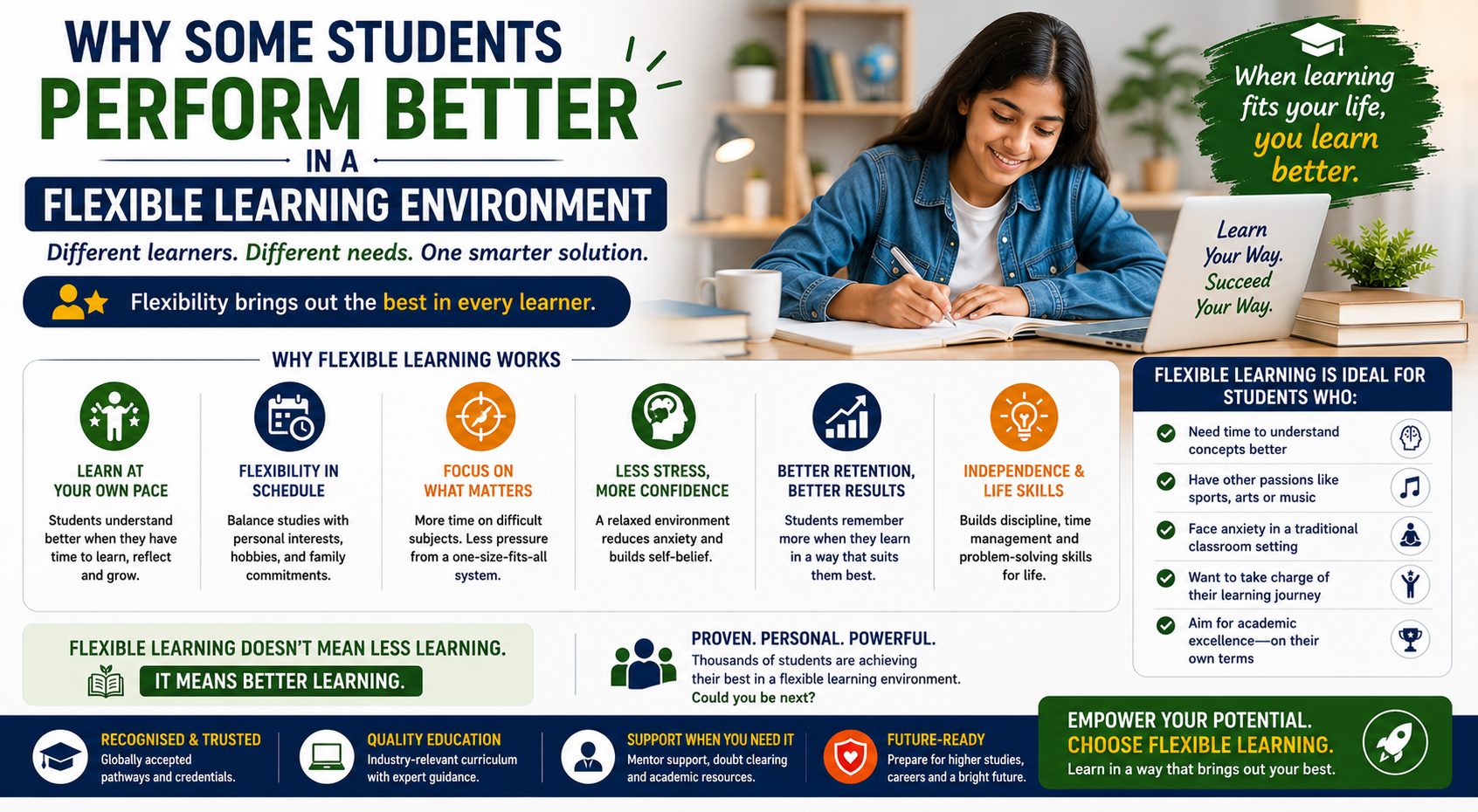
Walk into any traditional classroom and you will find a wide range of students — some thriving, some disengaged, and some quietly struggling. The curriculum is the same, the teacher is the same, and the timetable is identical for everyone. Yet the outcomes are vastly different. Why?
The answer lies not in the students themselves but in the learning environment. Not every student thrives under constant pressure, rigid schedules, and a one-size-fits-all approach to education. For many learners, a flexible learning environment is not just preferable — it is essential for genuine academic growth. At SchoolBase, Bangalore’s dedicated NIOS Study Centre, we see this reality every day. This article explores why some students genuinely perform better when given flexibility, and how structured open schooling through NIOS makes that possible.
1. Different Learning Styles Among Students
Educational psychology has long established that students do not all learn in the same way. Some are visual learners who absorb information best through diagrams, charts, and demonstrations. Others are auditory learners who understand concepts more deeply when they are explained aloud. Still others are kinaesthetic learners who need to physically engage with material — building, experimenting, writing — to truly retain it.
Traditional classroom teaching is primarily designed for one type of learner: the student who can sit still, listen for extended periods, take notes, and reproduce information under exam conditions. This model works well for a portion of the student population. For the rest — a significant portion — it creates chronic friction between how they learn and how they are taught.
A flexible learning environment removes this friction. Students can revisit difficult concepts at their own pace, engage with material in a way that suits their learning style, and demonstrate understanding through varied assessments rather than a single annual examination. This is one of the core advantages of the NIOS board in Bangalore — it is designed around the learner, not the institution.
2. Why Some Students Struggle in Traditional Classrooms
Traditional schooling creates specific conditions that disadvantage certain learners — not because those students are less capable, but because the environment does not match their needs.
- Fixed pace: The class moves forward regardless of whether every student has understood the current topic. Students who need more time fall behind quickly and rarely catch up.
- High-pressure assessment cycles: Frequent tests, unit exams, and terminal examinations create ongoing anxiety. For students who perform poorly under pressure, these assessments measure stress tolerance more than actual knowledge.
- Rigid timetables: Students who have outside commitments — sports training, health challenges, family responsibilities — cannot adapt the school day to their reality. Attendance requirements penalise them even when they are studying seriously outside school hours.
- Social dynamics: Bullying, social anxiety, and classroom competitiveness affect a significant number of students. For these learners, the classroom itself is an obstacle to learning rather than a support for it.
- Limited subject choice: Mainstream schools often require students to study a fixed set of subjects. Students whose strengths or interests lie outside this set are disadvantaged from the start.
None of these challenges reflect a student’s intelligence or potential. They reflect a structural mismatch between the student and the system. The NIOS Class 10 and NIOS Class 12 programmes at SchoolBase are specifically designed to address each of these challenges head-on.
3. Sports Students, Artists, Working Students, and Slow Learners
Flexible learning is not a single solution for a single type of student. It is a framework that benefits a wide range of learners who share one common challenge: their life or learning profile does not fit the standard classroom mould.
Sports Students and Young Athletes
A student who trains six hours a day for a sport cannot be expected to also sit in a classroom for seven hours and complete two hours of homework every evening. Young athletes in Bangalore — whether in cricket, football, badminton, swimming, or athletics — need an academic structure that respects their training schedule. NIOS allows these students to study when their energy is available and appear for examinations when they are ready, without forcing them to choose between their sport and their education. SchoolBase works with numerous sports students across Bangalore to ensure their academic progress keeps pace with their athletic development.
Performing Artists and Creative Students
Young musicians, classical dancers, theatre students, and visual artists often train under masters who require significant daily time commitments. Conventional schooling treats these pursuits as extracurricular — secondary to academics. Flexible learning through NIOS treats them as equally valid life pathways, allowing artistic students to pursue their craft without sacrificing educational credentials.
Working Students and Students with Family Responsibilities
Older students who need to contribute to household income, or students managing significant family responsibilities, cannot maintain conventional school attendance. NIOS gives these students a genuine second chance — or a first real opportunity — to complete their Class 10 or Class 12 qualification on a schedule that their life actually allows.
Slow Learners and Students with Learning Differences
Students with dyslexia, ADHD, autism spectrum disorder, or processing differences are consistently underserved by mainstream schooling. A classroom designed for neurotypical learners moving at the same pace is one of the most challenging environments these students can face. SchoolBase’s specialised NIOS coaching for slow learners provides 1-on-1 teaching, patient mentoring, and examination support tailored to each student’s specific needs. The result is not just academic certification — it is a genuine restoration of confidence and self-belief.
4. How Personalised Learning Improves Confidence and Performance
One of the most powerful effects of flexible, personalised learning is the impact it has on student confidence. In a traditional classroom, a student who consistently struggles feels the failure publicly — in front of peers, in red marks on returned papers, in being moved to lower sets. Over time, many of these students conclude that they are simply not academic. This belief becomes self-fulfilling.
Personalised learning breaks this cycle. When a student can work at their own pace without the constant comparison to others, something important happens: they begin to experience progress. Small wins accumulate. Concepts that seemed impenetrable become clear when given sufficient time and the right explanation. Confidence builds incrementally.
At SchoolBase, our counsellors design individualised study plans for every student — whether they are enrolled for NIOS Class 10, NIOS Class 12, or specialised pathways like our IIT JEE Pathway or Aviation Pathway Programme. This personalised approach consistently produces measurable improvements in both performance and student wellbeing.
5. Why Success Depends on Consistency, Not Just Strict Rules
There is a widespread belief that academic success requires strict rules, high pressure, and constant monitoring. The evidence from both educational research and real student outcomes tells a more nuanced story.
What drives long-term academic success is not pressure — it is consistency. A student who studies for two focused hours every day, six days a week, will outperform a student who studies frantically for twelve hours the night before an examination. The former is building genuine understanding; the latter is managing short-term anxiety.
Flexible learning environments, when supported by structured coaching, are exceptional at building consistency. Students who study according to a schedule that suits their life are far more likely to maintain that schedule over months than students who are forced into a routine that conflicts with their energy, interests, or commitments.
SchoolBase’s Personal Contact Programme (PCP) sessions, TMA guidance, and regular progress check-ins create the external structure that keeps students consistent — without the pressure that so often produces burnout rather than results. Students can also take the On-Demand Examination when they are genuinely ready, rather than appearing because a calendar date has arrived.
6. NIOS — A Structured Yet Flexible Solution
NIOS provides the ideal framework for flexible learning because it combines genuine academic rigour with genuine adaptability. The board’s Tutor Marked Assignments, practical examinations, and nationally standardised public examinations ensure that every student who earns a NIOS certificate has met the required academic standard. The flexibility lies in how and when students reach that standard — not in whether they must reach it.
For students in Bangalore, SchoolBase translates this framework into a concrete support system. From the moment of admission through to final certification, our team provides the academic guidance, practical support, and personal mentoring that flexible learners need to succeed. Review our fee structure and speak to our counsellors to understand what a personalised NIOS programme looks like for your child.
7. Conclusion: The Best Environment Is the One Where Students Stay Engaged
The best learning environment is not the most demanding one or the most structured one. It is the one where a student can stay engaged, remain motivated, and make steady, meaningful progress toward their goals.
For a significant proportion of students — athletes, artists, learners with different needs, students facing life challenges — that environment is a flexible one. Not unstructured. Not easy. But flexible enough to meet the student where they are, and structured enough to take them where they need to go.
If you are a parent or student in Bangalore looking for an education pathway that respects your child’s individuality while delivering nationally recognised results, SchoolBase is ready to help. Contact our team today and take the first step toward a learning experience that actually works for your child.
SchoolBase — NIOS Study Centre, Bengaluru
NIOS Affiliation Code: 080345
📞 +91 6361938556 | 🌐 www.schoolbase.in
📍 Arehalli, Bengaluru, Karnataka – 560061