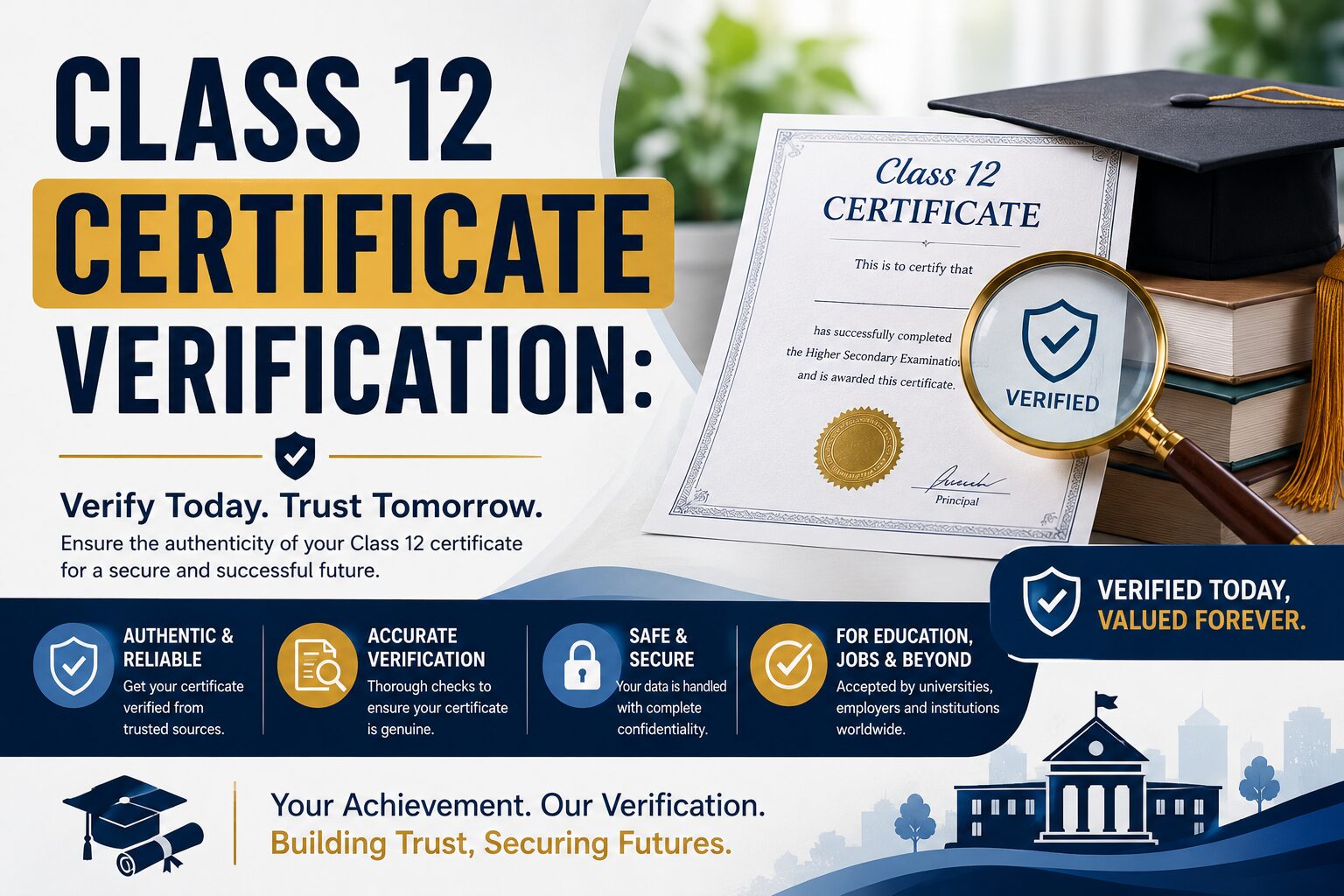
A parent approaches an education consultant with a simple question: “Can you help my child complete Class 12 and get a marks card?” The child may have discontinued regular school, faced academic difficulties, missed examinations, or the family may have relocated. A middleman may appear with the perfect answer: “Don’t worry, we can arrange Class 12,” showing sample marks cards, a website, and photographs of students. The parent feels relieved. The student eventually receives a marks card. Everything appears complete.
But the most important questions often begin after the marks card is received. Who actually issued it? Was the school properly affiliated? Is the board recognised for the student’s intended purpose? Can the result be independently verified? Will it be accepted by the university or course the student wants to join? These questions should be asked before admission and payment — not after a future has already been built around the qualification.
A Marks Card Is Not the Same as a Verified Qualification
A marks card can look completely genuine — name, photograph, roll number, marks, seal, QR code — but appearance alone does not establish recognition. Parents should separate three distinct questions: Is the document genuine? (was it actually issued by the stated school/board), Is the qualification recognised? (does the relevant authority recognise it under applicable rules), and Will it be accepted for my purpose? (does the specific university, employer, or regulator accept it). A document can be genuine but still fail to meet a particular course’s eligibility requirements. Never stop at “I have the marks card” — ask whether the qualification can be independently verified and used for the purpose you need.
The Middleman May Not Be Available Tomorrow
A consultant may handle the entire admission, communicate with the school, and collect documents — but a phone number can stop working, a WhatsApp account can disappear, and an office can move. The student is left holding a marks card with no one to contact for verification. An educational qualification should never depend entirely on the continued availability of one intermediary. Parents should identify the actual issuing authority from the start and retain their own records — admission documents, fee receipts, enrolment number, marks cards, and official contact information.
A Website Result Is Not the Same as Official Verification
A middleman may point to a website where a roll number search shows a result, which can feel reassuring. But the real question is: who operates this website, and what authority stands behind the qualification? A result appearing online does not, by itself, establish that the qualification will be accepted by every future institution. Verification should always trace back to the actual issuing authority.
Recognition Depends on the Purpose
Instead of asking “is this certificate recognised,” ask: “Recognised by whom, for what purpose, and under what current rules?” A genuine Class 12 certificate does not automatically mean every professional course will accept the student — engineering, pharmacy, medicine, and aviation programmes can each have specific subject, marks, and entrance requirements. Students planning professional education should check these requirements before selecting their Class 12 pathway, not after.
Foreign Boards, Passports, and Official Verification
Passport Seva’s official material states that where there is doubt about a submitted certificate’s genuineness, the Passport Issuing Authority may verify it directly with the issuing authority — a reminder that government bodies can and do independently verify documents. Similarly, AIU does not automatically grant equivalence to every foreign board; its criteria consider the recognised status of the school, qualification level, and mode and duration of study, and equivalence is not granted for certain open/online/home-study qualifications. Never assume “foreign board equals automatic acceptance everywhere.”
Red Flags Parents Should Not Ignore
Pause and verify independently if a middleman refuses to identify the awarding authority, says “don’t contact the board directly,” guarantees acceptance everywhere or passport approval, relies only on WhatsApp, or cannot explain how a university can verify the result. None of these alone proves wrongdoing, but together they are reasons to slow down.
Why NIOS Can Be a Recognised Option
NIOS is a national open schooling organisation offering Secondary and Senior Secondary education with flexibility in subject choice and pace of learning, backed by its own academic support and examination framework. In September 2025, AICTE reiterated to AICTE-approved institutions that valid NIOS qualifications should be treated at par with other recognised boards when students meet the prescribed eligibility criteria — an example of choosing a pathway based on a recognised framework rather than simply a document. Students must still meet the subject, marks, and entrance requirements of their intended course.
How SchoolBase Approaches These Cases
At SchoolBase, our first question is never “which marks card can we arrange” — it is “What does the student need this qualification for?” We review academic history, reasons for discontinuation, future plans, and eligibility before recommending a pathway, and we guide families through NIOS Class 10 admission, NIOS Class 12, and documentation requirements. We work in association with Presidency Public School – NIOS Study Centre, Code 080345, Bengaluru. Review our fee structure before deciding. SchoolBase does not issue NIOS certificates — NIOS is the relevant authority for its own programmes and certification.
Choose the Qualification First
Your child does not need merely a piece of paper — they need a qualification that can stand up to verification years later, when the middleman’s phone number has changed and the office has disappeared. Before choosing an alternative board, ask: who awards it, who recognises it, who can verify it, and will my child still be able to use it years from now? Choose the qualification first — the marks card should be the result of genuine education, not the reason for choosing the board.
Frequently Asked Questions
Can a marks card look genuine but still create problems later?
Yes. A document may appear genuine, but the relevant institution may still need to verify the underlying qualification or determine whether it meets current eligibility requirements.
What if the consultant who arranged admission disappears?
Contact the actual issuing school or board directly and seek independent verification. Keep all admission, payment, and academic documents.
Can a website result prove a qualification is recognised?
No. A result appearing online does not by itself establish recognition. Verify the issuing authority independently.
Does AIU automatically give equivalence to every foreign board?
No. AIU has specific criteria involving recognised status, qualification level, and mode and duration of study.
Should parents choose a board because it gives results quickly?
No. Recognition, verification, eligibility, and future usability matter far more than speed.
Need Guidance?
SchoolBase – NIOS Academic Guidance & Learning Support
NIOS Study Centre: Presidency Public School – Code 080345, Bengaluru
Website: www.schoolbase.in
Phone: 6361938556
Parents should always verify the latest admission, recognition, and examination requirements directly with the relevant authority before making an educational decision.
About the Author
Vinay Kumar, Academic Programme Coordinator, SchoolBase, Bengaluru, works with students and parents exploring NIOS Secondary and Senior Secondary pathways and coordinates academic support and counselling through SchoolBase. Last updated: August 2026. Information checked: August 2026.